Am I in a Toxic Relationship? Toxic Relationship Signs Hidden in Emotional Entanglement
Am I in a Toxic Relationship? Toxic Relationship Signs
Most people do not recognise a toxic relationship while they are inside it.
Recognition requires distance, and distance is precisely what these relationships deny. They operate through intimacy, through familiarity, through the slow erosion of certainty. One does not wake up one morning and discover toxicity. One adapts to it, adjusts to it, rationalises it. By the time the question appears – Am I in a toxic relationship? – the emotional landscape has already been reshaped.
Many individuals begin searching for toxic relationship signs only after months or even years of emotional confusion. The difficulty is that these signs rarely appear obvious in the beginning. Instead, they emerge slowly, hidden within everyday interactions and subtle shifts in emotional balance.
What makes such relationships difficult to identify is that they rarely appear violent in obvious ways. The violence is psychological, atmospheric. It exists in tone, silence, implication. It manifests not as overt cruelty but as a subtle rearrangement of emotional reality. Over time, the individual begins to doubt their own perception.
In therapeutic settings, this gradual erosion of self-trust is something practitioners encounter frequently. Approaches such as Family Constellation Therapy often reveal how relationship dynamics can be influenced by deeper systemic patterns within families, while Inner Child Healing helps individuals understand how early emotional experiences shape the way they attach, trust, and respond within intimate relationships.
The most effective toxic dynamics are those that do not look like conflict.
They look like intimacy.
The Psychology of Emotional Distortion Behind Toxic Relationship Signs
A toxic relationship is not simply one characterised by disagreement or unhappiness. All relationships contain friction. Toxicity emerges when friction becomes structural – when emotional imbalance is no longer accidental but embedded in the relationship itself.
One partner gradually assumes control over the narrative of reality. They decide which feelings are legitimate, which concerns are exaggerated, which memories are accurate. The other partner begins to experience an unsettling phenomenon: their inner world becomes unreliable.
In psychological research, this phenomenon often overlaps with what is called gaslighting, a form of manipulation in which a person is made to question their perception of events. Studies published in the Journal of Interpersonal Violence indicate that individuals exposed to sustained emotional manipulation show increased levels of anxiety, cognitive confusion, and emotional dependency.
But statistics do not capture the lived experience. The more disturbing element is how normal these dynamics can appear.
Why Do Intelligent Women Remain in Toxic Relationships?
There exists a persistent cultural myth that emotional vulnerability belongs only to the naïve. In reality, many women who find themselves in toxic relationships are highly educated, professionally accomplished, and socially perceptive.
The paradox is precisely this: the very qualities that make someone empathetic, thoughtful, and reflective can also make them susceptible to prolonged emotional negotiation.
Women are often trained – socially, culturally, even professionally – to maintain relational harmony. They listen carefully. They attempt to understand motivations. They offer emotional labour as a form of care. In environments where personal and professional identities are intertwined, relationships often carry the weight of stability, reputation, and social continuity.
Leaving a relationship, therefore, does not always appear as a rational choice.
It appears as disruption.
In metropolitan life, where professional success is frequently paired with the expectation of relational stability, many women internalise the belief that emotional difficulties are problems to be solved rather than signals to be heeded.
The result is endurance.
9 Toxic Relationship Signs That Often Go Unnoticed
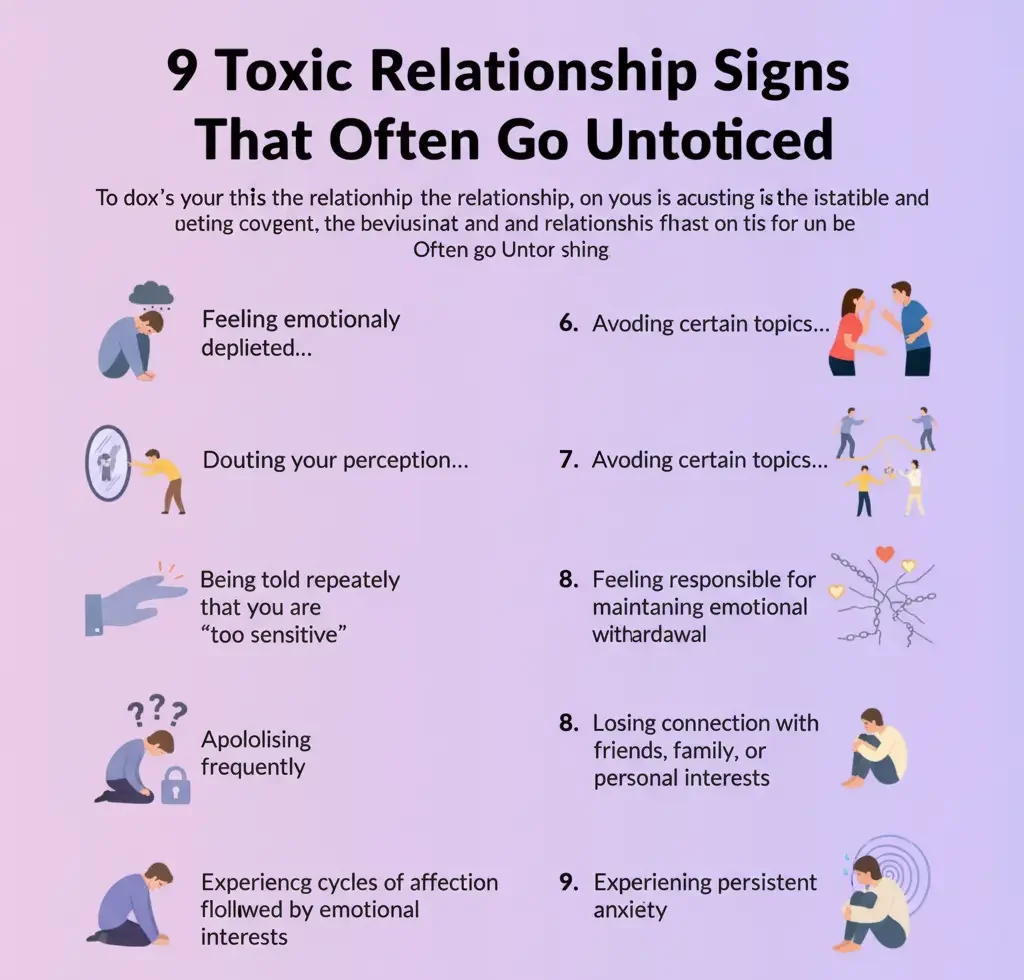
Recognition, however, begins with observation. Toxic relationship signs often appear not through dramatic conflict but through repetitive emotional patterns that gradually reshape how a person experiences themselves within the relationship.
Common indicators include:
- Feeling emotionally depleted after interactions with your partner
- Doubting your perception of events or conversations
- Being told repeatedly that you are “too sensitive” or “misunderstanding things”
- Apologising frequently without clarity about what you did wrong
- Experiencing cycles of affection followed by emotional withdrawal
- Avoiding certain topics because you anticipate conflict
- Feeling responsible for maintaining emotional balance in the relationship
- Losing connection with friends, family, or personal interests
- Experiencing persistent anxiety about the relationship’s stability
Individually, these signs may appear minor. Together, they form a pattern.
Patterns, not incidents, reveal the nature of relationships.
The Physiological Consequences
Toxic relationships are not merely emotional phenomena; they are physiological experiences.
The human nervous system is exquisitely sensitive to relational stress. Research conducted by the American Psychological Association has shown that individuals in high-conflict relationships exhibit chronically elevated cortisol levels, a biological marker associated with prolonged stress.
Over time, this state of hyper-alertness produces symptoms that many people fail to associate with relationships: sleep disturbances, fatigue, digestive disorders, headaches, and weakened immune function.
In other words, the body understands what the mind often resists.
It registers instability even when language attempts to deny it.
The Difficulty of Leaving a Toxic Relationship
One of the defining features of toxic relationships is their cyclical nature.
Periods of tension are often followed by moments of warmth or reconciliation. The partner who once seemed dismissive becomes attentive again. Promises are made. The atmosphere softens.
Psychologists refer to this dynamic as intermittent reinforcement, a behavioural pattern known to strengthen emotional attachment. The unpredictability itself becomes addictive.
Hope functions as the glue.
The relationship persists not because it is consistently fulfilling but because it occasionally is.
The Hidden Architecture of Relationship Patterns
Another dimension complicates the question of toxicity: family history.
Human relationships rarely exist in isolation. They are shaped by early experiences of attachment, belonging, and emotional safety. Family Constellation Therapy, a systemic approach developed by Bert Hellinger, proposes that many relational dynamics originate not solely in personal choice but in unconscious loyalties within family systems.
Individuals may unknowingly replicate patterns they observed growing up – conflict, emotional distance, imbalance of power – because these dynamics feel familiar.
Familiarity is often mistaken for compatibility.
Understanding these hidden patterns does not excuse harmful behaviour, but it illuminates why certain relational dynamics feel strangely inevitable.
A Deeper Exploration
For those who find themselves repeatedly entering similar relationship dynamics, it can be valuable to explore the systemic patterns underlying these experiences.
Family Constellation Sessions offer a way to examine hidden influences within family systems that may shape present relationships. By bringing these dynamics into awareness, individuals often gain clarity about patterns that previously felt inexplicable.
If you would like to explore this work further, you can learn more here:
Book a Family Constellation Session
Sometimes the most radical act is not leaving a relationship.
It is seeing it clearly.
FAQs
Common toxic relationship signs include emotional manipulation, constant criticism, gaslighting, feeling drained after interactions, repeated cycles of affection and withdrawal, and constantly doubting your own perception or feelings.
You may be in a toxic relationship if you frequently feel anxious, emotionally exhausted, or responsible for maintaining the emotional balance of the relationship. Repeated patterns of blame, manipulation, or psychological control are also strong indicators.
Gaslighting is a form of psychological manipulation where one partner causes the other to doubt their memory, perception, or reality. Over time, this can lead to confusion, loss of self-confidence, and emotional dependency.
People often stay in toxic relationships due to emotional attachment, hope that the partner will change, fear of loneliness, financial dependence, or unconscious relationship patterns formed during childhood.
Yes. Long-term exposure to toxic relationship dynamics can lead to anxiety, stress, sleep disturbances, emotional burnout, weakened immunity, and other physical symptoms caused by chronic stress.
Subtle signs include guilt-tripping, silent treatment, dismissing your feelings, making you feel overly responsible for the relationship’s stability, and repeatedly shifting blame during conflicts.
Yes. Therapeutic approaches such as systemic therapy, emotional healing work, and family constellation sessions can help individuals understand hidden relationship patterns and develop healthier relational boundaries.
Healing often begins with awareness, emotional support, rebuilding self-trust, reconnecting with personal boundaries, and exploring deeper relationship patterns through therapeutic guidance.