
Introduction
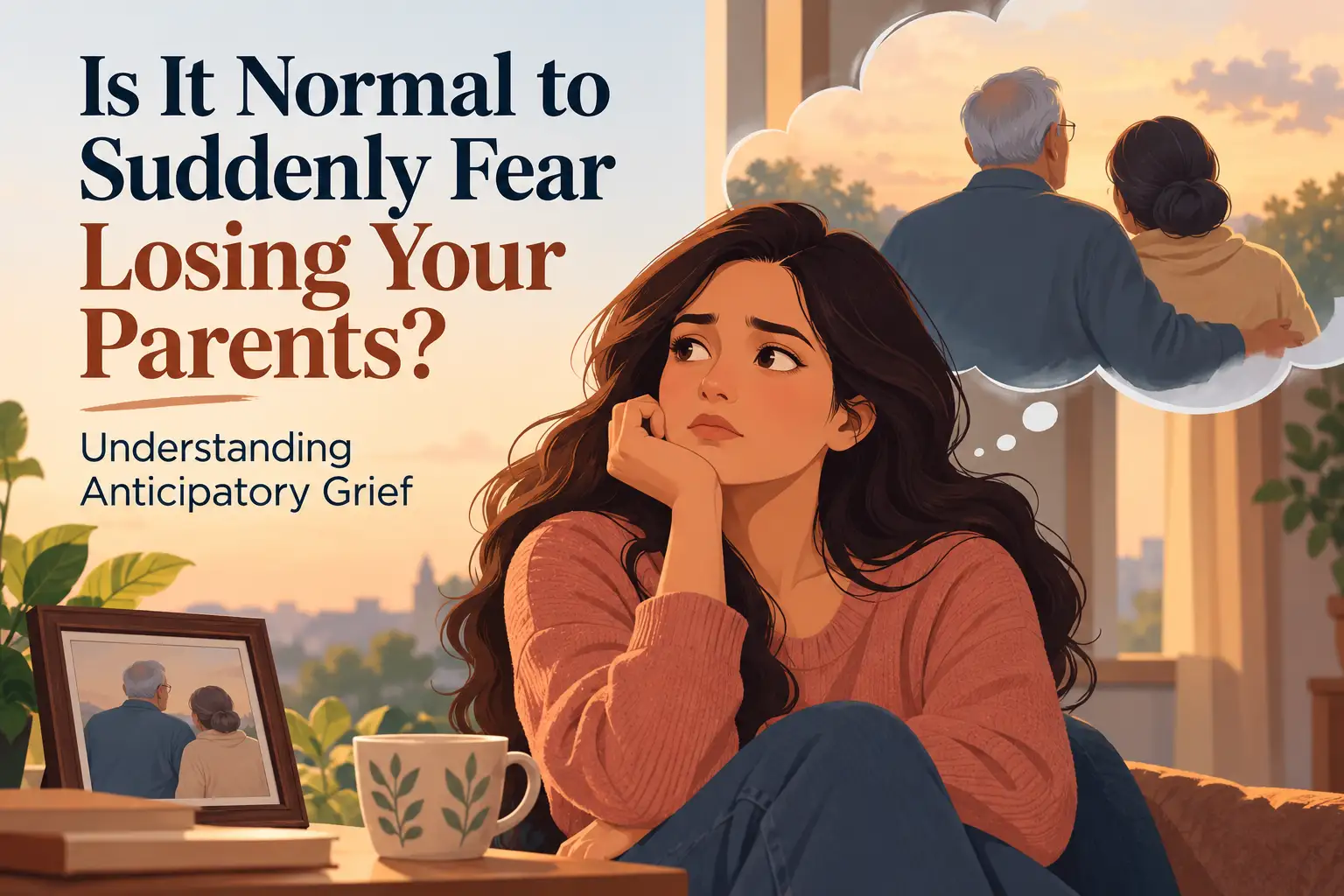
What Is Anticipatory Grief?
Anticipatory grief was first named by psychiatrist Erich Lindemann in 1944, in his landmark paper on the grief responses of soldiers’ wives who feared their husbands would not return from war. He observed that some wives were already grieving, with the full emotional, cognitive, and behavioural characteristics of bereavement, before any loss had occurred.
Since Lindemann, the concept has been significantly developed. Dr. Therese Rando, one of the foremost researchers in grief studies, defines anticipatory grief as “the phenomenon encompassing the processes of mourning, coping, interaction, planning, and psychosocial reorganization that are stimulated and begun in part in response to the awareness of the impending loss of a loved one.”
In the context of ageing parents, anticipatory grief typically begins not at a specific medical diagnosis but at a subtler threshold: the moment, often in one’s 30s or 40s, when the immortality illusion dissolves. When the abstract knowledge that parents are mortal becomes a felt, embodied reality that can no longer be held at arm’s length.
Why It Feels Disproportionate
One of the most disorienting aspects of anticipatory grief is that it can feel entirely out of proportion to the current situation. Your parents may be reasonably well. There may be no immediate medical concern. And yet the fear can be intense, the grief real, the preoccupation persistent.
There are several reasons for this apparent disproportionality:
The uncertainty is its own burden. Actual loss has a kind of terrible clarity. Anticipatory grief exists in the fog of not-knowing, when, how quickly, what it will be like, and the nervous system finds sustained uncertainty particularly difficult to process. Research by psychologist Daniel Gilbert at Harvard has shown that the imagination of loss often produces more intense distress than the actual experience of loss, partly because the imagination has no access to the adaptive mechanisms (meaning-making, social support, distraction) that the real experience activates.
It carries multiple grief layers. Anticipatory grief of a parent is rarely only about the future loss. It often activates grief for the relationship as it has been, the relationship that never was, the childhood that was imperfect, the repair that has not happened, the things that have been unsaid. The fear of losing the parent is sometimes inseparable from the grief of what was never fully had. Approaches such as Family Constellation Therapy can help trace where these unspoken family patterns first took shape.
It touches mortality more broadly. The ageing of our parents confronts us with our own. They are the generation ahead of us. When they go, we move to the front of the line. This existential dimension, the meeting with one’s own mortality, is part of what makes the anticipatory grief of parents particularly potent.
What Anticipatory Grief Looks Like
It does not always announce itself as grief. Its presentations include:
Hypervigilance about their health. Elevated anxiety in response to any symptom, any missed call, any mention of tiredness. A scanning quality, always monitoring for signs of decline.
Difficulty being fully present with them. Because you are already, in part, mourning. The future loss overlays the present encounter.
Urgency about unfinished business. A sudden sense that conversations need to happen, repair needs to be attempted, things need to be said before the window closes. This urgency, while uncomfortable, is often one of the most generative aspects of anticipatory grief.
Emotional flooding in unexpected moments. A song, a smell, a particular quality of afternoon light, and the grief arrives, full and immediate, apparently from nowhere.
Preoccupation and intrusive thoughts. The scenario plays out repeatedly in the mind: what will it be like, how will I manage, what if I wasn’t there.
Physical symptoms. Chest tightness, fatigue, sleep disruption. The body participates in the anticipation as it would in actual loss.
The Psychology of Parental Loss
Understanding why the loss of a parent is psychologically distinctive helps make sense of why anticipatory grief around that loss is so significant.
Research by grief psychologist John Bowlby, whose attachment theory revolutionised developmental psychology, identified parents as our primary attachment figures: the first relationships through which we learn what love, safety, and belonging feel like. Even in adulthood, even with parents from whom we are geographically and emotionally independent, the attachment bond persists at a deep neurological level.
The loss of an attachment figure is not simply the loss of a person. It is the loss of a particular quality of felt safety in the world: a groundedness that comes from knowing that the person who first held us still exists somewhere.
For many people, the mother represents emotional home, the original source of nurture, comfort, and relational safety. Her loss, or the anticipation of it, carries the grief of potentially losing the internal representation of that safety.
The father, in many attachment patterns, represents a different but equally significant function: external orientation, safety in the world, authority and structure. His loss or anticipated loss often activates fears about foundational stability and identity.
Neither of these is universal, individual attachment histories vary enormously, but the pattern is consistent enough in clinical and research literature to be worth noting. This is precisely why anticipatory grief tends to take on a different emotional shape depending on which parent is involved. When these attachment bonds carry unresolved wounds, Inner Child Therapy can help address the deeper layers beneath the anticipatory fear.
What Anticipatory Grief Is Asking of You
This is the reframe that I have found most useful with clients navigating this experience: anticipatory grief, for all its difficulty, is also an invitation.
An invitation toward repair. If there are things unsaid, conversations unfinished, ruptures unaddressed, the anticipatory grief is often pointing directly at them. The window is not closed. It is, right now, open.
An invitation toward presence. The preoccupation with future loss can be redirected, with intention, toward fuller presence in the current relationship. Not as a denial of the grief, but as its complement.
An invitation toward your own mortality. The existential confrontation that accompanies the ageing of parents, while unwelcome, is one of the more reliable catalysts for examining what matters, what has been deferred, what you want your life to actually contain.
An invitation toward support. Anticipatory grief is isolating, partly because it feels premature, partly because there is no socially recognised space for it. Finding a therapist, a support group, or a trusted companion who can hold the experience without dismissing it is often one of the most important steps.
A Note on Inner Child Work
For many people, the anticipatory grief of a parent is layered with material that predates the current relationship: the grief of the childhood self for what was not received, the longing for repair that has persisted for decades, the fear of losing the parent before the relationship has become what you needed it to be.
Inner Child therapy offers a structured way to work with this layering, separating what belongs to the adult’s genuine present-day anticipatory grief from what belongs to the younger self’s older grief, and addressing both with appropriate care.
This is not about complicating or pathologising a natural human experience. It is about meeting the full depth of what the experience contains, so that the grief can move, as grief is designed to, rather than accumulating in the body as unresolved residue.
Conclusion
Anticipatory grief can feel disorienting precisely because it arrives ahead of any actual loss, often with no clear trigger and no obvious place to put it. But it is not a sign that something is wrong with you. It is a deeply human response to loving people who will not be here forever.
Rather than pushing the fear away or waiting for it to make sense, it helps to treat it as information: an invitation toward repair, presence, and support, while there is still time. And where the fear connects to older, unfinished material from childhood, working with that layer, including through Inner Child therapy, can help the grief move rather than settle into the body unresolved.
References
- Lindemann, E. (1944). Symptomatology and management of acute grief. American Journal of Psychiatry, 101(2), 141–148.
- Rando, T.A. (1986). Loss and Anticipatory Grief. Lexington Books.
- Bowlby, J. (1980). Attachment and Loss, Vol. 3: Loss: Sadness and Depression. Basic Books.
- Gilbert, D. (2006). Stumbling on Happiness. Knopf.
- Worden, J.W. (2008). Grief Counselling and Grief Therapy. Springer.
Where to start
If any of this describes something you recognise, the first step is a conversation rather than a commitment. A free consultation exists to work out what would genuinely help — including saying plainly if this is not the right approach for you.