
Introduction
Morning: helping her 9-year-old with a school project while managing her 6-year-old’s meltdown about breakfast. Afternoon: taking her mother to a medical appointment, sitting in a waiting room for two hours, managing the conversation about medication with a doctor who spoke too quickly. Evening: putting the children to bed, calling her father to reassure him about her mother’s appointment, answering work emails that had accumulated through the day, and finally sitting down at 10pm to eat something she had reheated twice.
“There is no part of that day,” she said, “that belongs to me.”
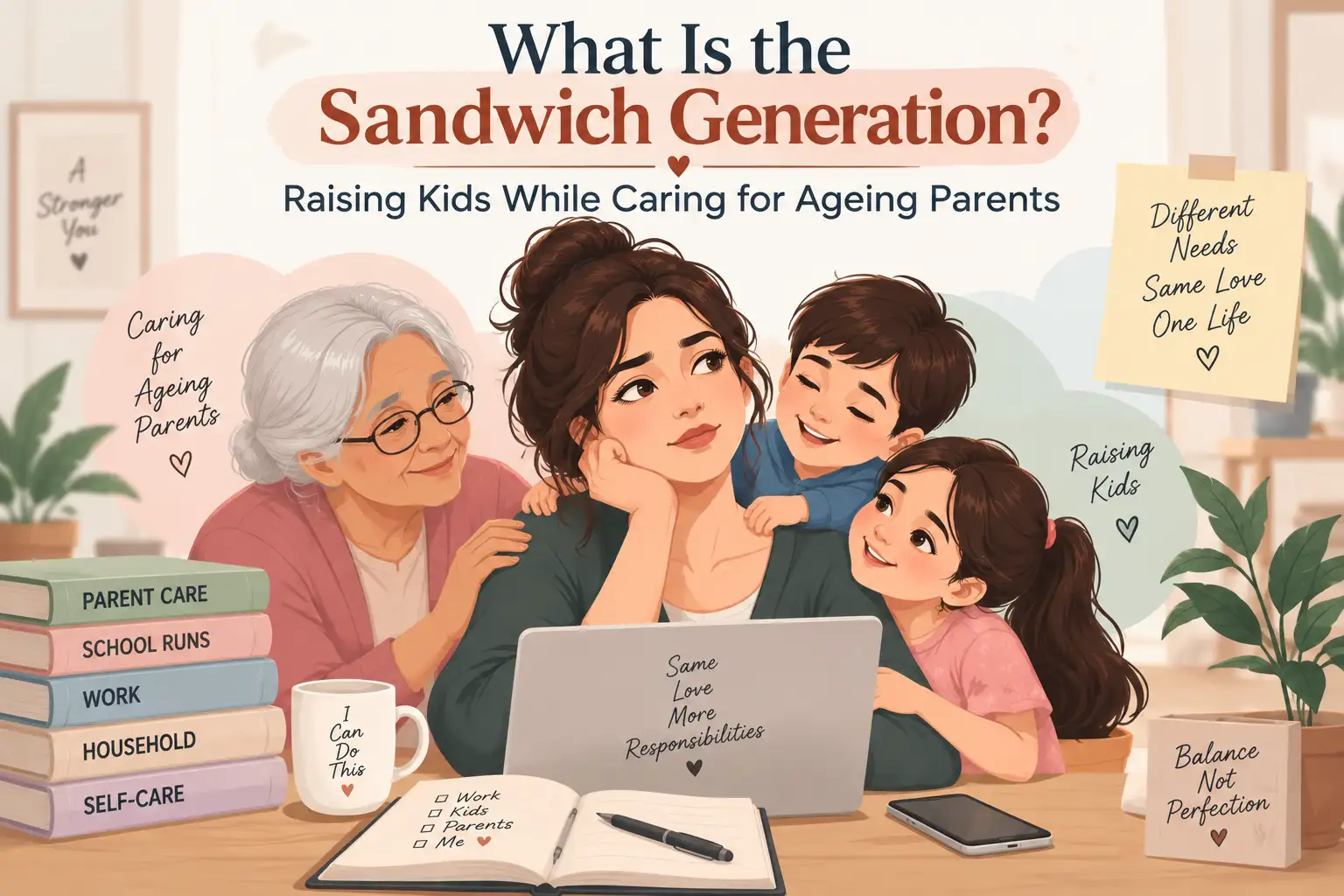
This is the Sandwich Generation. Not a metaphor a lived structural reality for millions of adults, disproportionately women, in their 30s through 50s, who are simultaneously raising the generation below them and caring for the generation above. What she needed, more than another item checked off her list, was a space where her own nervous system carrying all of it could simply be tended to, something Access Bars sessions are designed to offer.
What Is the Sandwich Generation?
The term was coined by social worker Dorothy Miller in 1981, who used it to describe adults caught between the competing demands of dependent children and ageing parents.
In the decades since, the sandwich has become more common, not less. Several converging demographic trends have contributed:
Later parenthood. The average age of first-time mothers has risen significantly from 21 in 1970 to 27 in 2021 (CDC data). Women who have children in their early 30s are still raising those children when their parents reach the age of significant health decline.
Longer parental longevity. Medical advances mean that people are living longer but not always in good health. The period of parental dependence has extended, and the nature of care required has often intensified.
The erosion of care infrastructure. The formal support systems that once partially absorbed elder care extended family networks, community structures and affordable professional care have diminished in many contexts, particularly in urban India, where nuclear family structures are increasingly the norm.
The result: the middle generation carries more, with less support, for longer.
Who Is Most Affected
Research consistently finds that the sandwich burden falls disproportionately on women.
A Pew Research Center analysis (2013) found that women are significantly more likely than men to be providing regular care to both an ageing parent and a child simultaneously. They spend more hours in direct caregiving, more hours in coordination and emotional management of care, and are more likely to have reduced their working hours or taken career breaks in response to caregiving demands.
In the Indian context, the disproportionate falls even more sharply. Cultural expectations around daughters’ and daughters-in-law’s responsibility for both child-rearing and parent care create a particular and often unacknowledged burden. Research on gender and unpaid labour in India consistently finds that women regardless of their professional status carry the majority of both childcare and elder care labour.
The Physiological Cost
The sandwich generation does not only experience stress as a subjective feeling. It registers in the body with measurable biological consequences.
Research by Elissa Epel and colleagues at UCSF found that the stress of caregiving was associated with accelerated cellular ageing measured by shortened telomeres equivalent to up to 17 additional years of biological ageing in the most stressed caregivers.
Studies of sandwich generation adults consistently show:
- Elevated cortisol and disrupted HPA axis function
- Suppressed immune activity and increased susceptibility to illness
- Higher rates of depression and anxiety than age-matched peers
- Significantly poorer sleep quality
- Higher rates of cardiovascular disease
These are not soft statistics. They describe a population that is, in measurable biological terms, ageing faster and getting sicker because of the structural demands placed on them.
The Invisible Dimension: Emotional Labour
Beyond the physical and practical demands of the appointments, the school runs, the medication management, the financial coordination the sandwich generation carries an enormous and largely invisible emotional labour.
The emotional labour of managing a parent’s fear and grief about their own decline. Of maintaining a marriage or partnership that is being squeezed at every edge. Of being present enough for children who are growing through developmental stages that will not repeat. Of managing the guilt of never quite doing enough for either generation. Of maintaining professional competence and engagement while running on empty.
None of this appears in the task list. All of it costs something.
What the Stress Is Really About
Underneath the logistical complexity, something else is often operating: the particular grief of midlife, in which the person in the middle is confronted, simultaneously, with both generations’ mortality.
The ageing parents are approaching their end. The children are moving toward independence. The person in the middle is, in some respects, watching both simultaneously the generation that preceded them declining and the generation they are raising moving toward the autonomy that will eventually not need them. This double confrontation can produce a specific existential quality to the stress that goes beyond the logistical.
There is also, for many sandwich generation members, a resurfacing of childhood dynamics. The relationship with the ageing parent activates old patterns: the responsible child, the emotional manager, the one who must hold everything together that may be more exhausting than the practical tasks because they are so deeply wired.
What Helps
Acknowledging the Structural Reality
The sandwich situation is not a personal failing or a consequence of poor time management. It is a structural condition. Acknowledging this and releasing the shame and self-blame that often accompany it is not a small thing. It is the beginning of addressing it honestly.
Redistributing Care
Where possible, and this is not always possible: redistributing the care burden. Involving siblings, partners, or professional care services even in small ways can significantly reduce the physiological and psychological cost on the primary caregiver. The resistance to this (“no one else does it properly”) is often connected to deep patterns around responsibility and control that are worth examining.
Protecting Pockets of Self
The instinct, under pressure, is to eliminate everything non-essential. The person’s own needs rest, pleasure, connection, creative expression become the first casualty. This is counterproductive: the depletion of the resource accelerates the decline in its quality. Protecting even small pockets of genuine self-replenishment is not selfish. It is sustainable.
Nervous System Support
Access Bars, somatic therapies, yoga, and mindfulness-based approaches all offer evidence-informed support for the nervous system dysregulation that sustained sandwich-generation stress produces. These are not luxuries. For someone in a prolonged caregiving situation, they are part of the infrastructure of sustainability.
Professional Support
Access Bars, somatic therapies, yoga, and mindfulness-based approaches all offer evidence-informed support for the nervous system dysregulation that sustained sandwich-generation stress produces. These are not luxuries. For someone in a prolonged caregiving situation, they are part of the infrastructure of sustainability.
References
- Pew Research Center (2013). The Sandwich Generation: Rising Financial Burdens for Middle-Aged Americans.
- Epel, E.S. et al. (2004). Accelerated telomere shortening in response to life stress. PNAS, 101(49).
- NCAER (2022). Gender and Unpaid Labour in India.
- American Psychological Association (2019). Stress in America.
- Hochschild, A.R. (1989). The Second Shift. Viking.
If you are in the sandwich generation and your nervous system is showing the cost, Access Bars sessions offer a genuinely restorative space. Contact us to find out more.
Where to start
If any of this describes something you recognise, the first step is a conversation rather than a commitment. A free consultation exists to work out what would genuinely help — including saying plainly if this is not the right approach for you.