
She moved from Lucknow to Bangalore at 26 for a job that became a career that became a life.
Seventeen years later, she has a husband, two children, a leadership role, and a family WhatsApp group where she is, by a wide margin, the most responsive member. She sends money. She arranges medical appointments from her laptop. She flies home for every health scare and calls her parents every evening on her commute.
And still she carries a guilt so heavy that, in her words, it has become “just part of who I am. Like a fifth limb that I can’t get rid of and nobody can see.”
If you care for ageing parents from another city or another country, you may recognise this feeling, even if you’ve never had a name for it. Long-distance caregiver guilt is rarely talked about openly, yet many people live with it quietly. This article looks at why it feels so heavy, what it is often really about, what you can do with it, and how family constellation therapy approaches the deeper family patterns behind it.
Why Long-Distance Caregiving Feels So Hard
All caregiver guilt grows out of a gap between what we feel we should give and what we are actually able to give. Distance widens that gap in a few specific ways.
You hear about it after the fact. When a parent falls, or a diagnosis comes, or a bad night turns frightening, you find out by phone. You can’t physically respond. This helplessness is real and structural, not imagined, and it is one of the hardest parts of caring from afar.
You rely on what you’re told. What you know about your parents’ daily life depends on what they choose to share, and many parents play down difficulties so their children won’t worry. You may know less than you think about how they are really doing.
Distance becomes the evidence. In many families, being physically present is how care is measured. The evening calls, the money, the flights get overlooked. The distance is what is noticed and remembered.
Visits come with their own weight. Visits are precious and short. They carry everything that has built up between them, and part of the time is often spent already dreading the goodbye. Being there can be dimmed by the grief of leaving again.
What Long-Distance Guilt Is Usually Really About
Persistent caregiver guilt is rarely just about the specific things you aren’t doing. It usually carries something else along with it.
Grief for the relationship as it is now. Shared meals, casual chatter, the texture of ordinary togetherness don’t travel well over a phone. That loss is real, and the guilt often has grief folded inside it.
Mixed feelings about leaving. The move that created the distance was, in most cases, a valid choice, made for work, for a partner, for a different life. But as parents age, ambivalence about that choice can quietly feed the guilt.
A cultural story about the “good child”. In many Indian families and communities, living close is treated as the sign of devotion. The child who stays is the dutiful one. The child who leaves carries an unspoken accusation of having put themselves first. Nobody may say it aloud, but it still works on you. Studies of caregiving in India also suggest that this expectation tends to fall more heavily on women.
Fear of the irreversible. The particular fear of distance caregiving is that something will happen and you won’t be there: the call that comes too late, the goodbye that never happens. Much of the guilt’s intensity comes from here.
Separating Real Limits From Impossible Standards
One of the most useful things you can do is sort what is weighing on you into two lists.
Things you genuinely can’t do from a distance. You can’t be at the hospital at 2 a.m. when your father falls. These are limits, not failures. They come with the choice to build a life elsewhere, and accepting them means letting go of a standard that asks for what geography makes impossible.
Things you could do but aren’t doing. These deserve an honest look. Could you visit more often, put more toward professional care, or call more regularly? Some of these may be within reach. Look at them practically, without guilt-driven overcorrection, such as flying home every other weekend until you burn out.
Much of the guilt spends its energy on the first list, feeling terrible about things that simply aren’t possible, instead of on the second, where action is available.
Practical Ways to Care From a Distance
Have someone on the ground, and a plan. Think about who can step in when you can’t: a trusted relative, a neighbour, the family doctor, or a care service. Agree in advance on who calls whom in an emergency, and keep key medical details and contacts where you can reach them. It won’t remove the helplessness, but it can soften it.
Ask more specific questions. “How are you?” usually gets “All fine, don’t worry.” Try “What did you have for lunch today?” or “Did you sleep through the night?” Specific questions tend to get truer answers.
Build connection that isn’t about health logistics. A regular call that isn’t mainly about medicines and appointments. Watching the same film or reading the same book. A video call over a meal in two different cities, or a walk described in real time. Presence is not only physical.
Put resources into professional support. If you can’t be nearby, money directed toward good medical care, home help, or companionship can narrow the gap considerably without asking the impossible of you.
Say what is still unsaid. Long-distance guilt often sits on top of conversations not yet had, or repair not yet attempted. Distance is not the obstacle to these. A phone call is enough to begin.
Find people in the same situation. This guilt is isolating because it is rarely acknowledged. Online or in-person communities can ease the shame that makes it heavier.
When the Guilt Doesn’t Ease
Sometimes the guilt stays out of proportion to what you are actually doing, even after you’ve sorted the limits from the choices. When that happens, it may be tied to something older: the role you held in your family as a child, unspoken loyalties, or beliefs about who stays and who leaves.
Family Constellation therapy is one approach people use to look at these family patterns with guidance. Experiences vary, and formal research on it is still limited, so it works best as a complement to, not a replacement for, psychotherapy or medical care. If your guilt comes with persistent low mood, anxiety, or trouble sleeping, please also speak with a qualified mental health professional.
Frequently Asked Questions
Is it normal to feel guilty when I live far from my parents?
Yes. Feeling guilty about the gap between what you’d like to do and what distance allows is very common. It doesn’t mean you are a bad son or daughter.
How can I care for ageing parents from another city or country?
Many people combine a local point person, professional care or home help, regular and specific check-ins, and a shared emergency plan. What works depends on your parents’ health and your own circumstances.
What if my parents hide how bad things are, or refuse help?
This is common. Specific questions, a trusted local contact, and speaking to their doctor (with their consent) can help you see more clearly. Respecting their wishes while staying involved is often a balance worth discussing openly.
Should I move back to be with my parents?
There is no single right answer. It depends on your parents’ needs, your family, your work, finances, and your own wellbeing. Guilt alone is not a reliable guide. It can help to talk it through with your parents, your siblings, and, if needed, a counsellor.
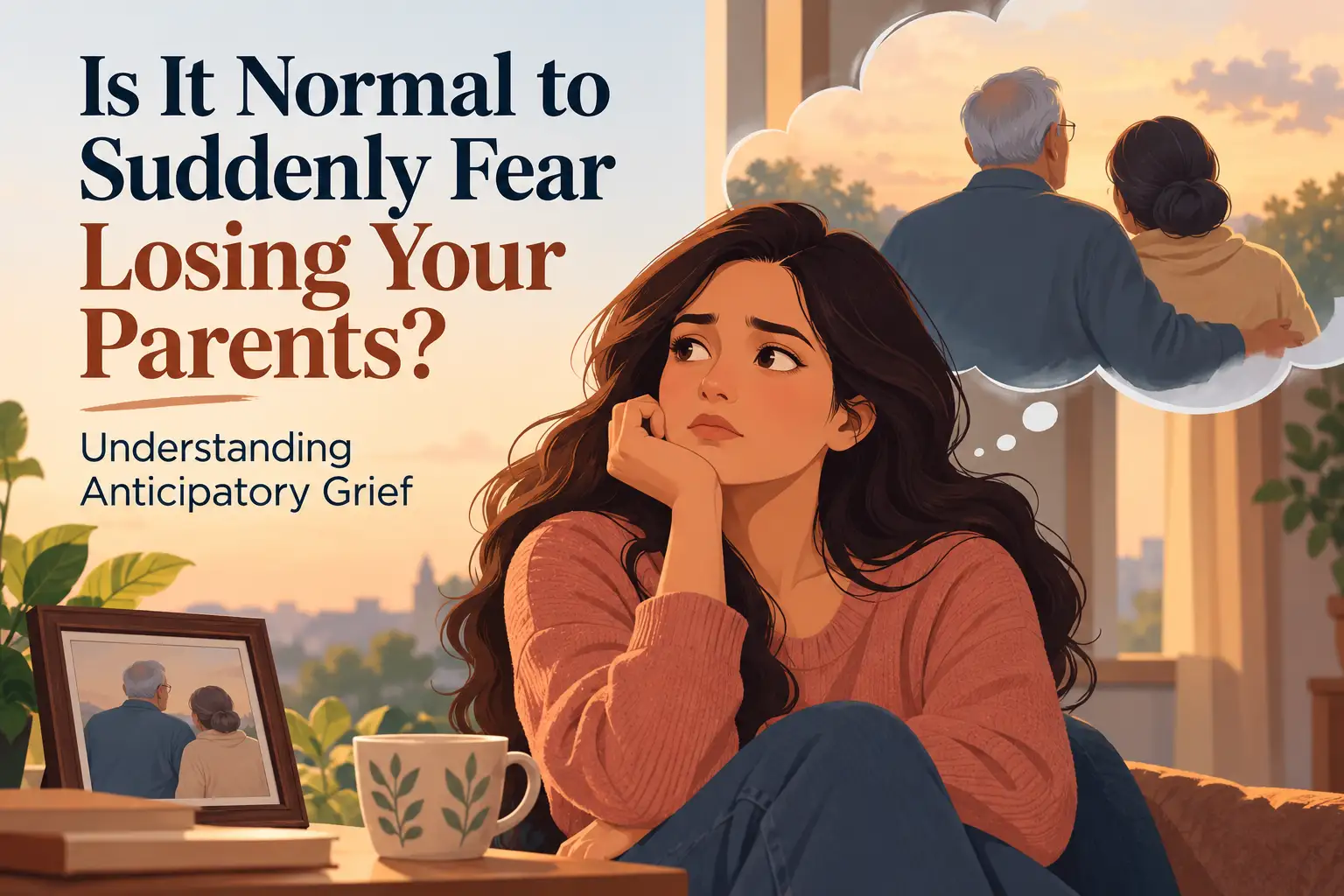
Can guilt about ageing parents be a sign of anticipatory grief?
Sometimes, yes. Many adult children begin grieving the changes in a parent before any loss has happened. Naming this grief can make the guilt feel less confusing.
Further Reading
- ICRW & Equimundo. Centering Care & Men’s Roles in Caregiving (India study). Rohini Nilekani Philanthropies.
- Sonobe, T., Sedai, A.K., Sinha, A. & Rahut, D.B. (2025). Elderly caregiving: A gendered analysis on caregivers’ labor, time-use, and well-being. Asian Economic Papers, 24(1), 159–177.
- Worden, J.W. (2008). Grief Counseling and Grief Therapy (4th ed.). Springer.
Where to start
If any of this describes something you recognise, the first step is a conversation rather than a commitment. A free consultation exists to work out what would genuinely help — including saying plainly if this is not the right approach for you.