Anxiety can make even an ordinary day feel demanding. Your mind keeps preparing for what might go wrong, your body feels tense, and switching off can seem almost impossible. EFT tapping is one self-help technique some people use to pause, notice what they are feeling, and approach an anxious moment with more awareness.
In this guide, we’ll look at what EFT tapping is, what happens during a tapping round, and how you can try a simple routine for anxious thoughts. We’ll also look at what current research can and cannot tell us about it.
What Is EFT Tapping?
Emotional Freedom Techniques (EFT), often called tapping, is a structured self-help approach that combines attention to an uncomfortable thought or feeling with gentle tapping on selected points on the face and upper body. People usually focus on one specific concern while repeating a short, accepting statement.
The method is sometimes described as acupoint tapping because the points used are based on locations associated with traditional acupressure. In a typical round, you identify what is bothering you, rate how intense it feels, tap through a sequence of points, and then check whether the intensity has changed.
EFT is not simply positive thinking. The intention is not to force yourself to feel calm or pretend that a difficult situation does not matter. Instead, you acknowledge what is happening while giving yourself a structured way to stay with the feeling for a short period.
Why Can Anxiety Be So Difficult to Switch Off?
Anxiety is not always a dramatic episode. Sometimes it looks like repeatedly checking your phone, replaying a conversation, imagining several possible outcomes, or feeling uneasy even when nothing urgent is happening.
For some people, worry becomes a way of trying to prevent mistakes or prepare for uncertainty. You may find yourself asking, “What if I disappoint someone?”, “What if something goes wrong?” or “What if I cannot handle it?” The mind keeps searching for certainty, but the search itself can become exhausting.
Anxiety can also show up physically. You might notice a tight jaw, tense shoulders, a restless stomach, shallow breathing, or difficulty settling down at night. These experiences can have different causes, so persistent or severe symptoms deserve proper assessment rather than being automatically attributed to stress.
If overthinking is a familiar part of your anxiety, you may also find it useful to read How to Stop Overthinking. It explores why mental loops continue and why trying to force thoughts away does not always work.
How EFT Tapping May Help With Anxiety
EFT gives you a short sequence to follow when a particular worry feels difficult to sit with. Rather than moving from one anxious thought to another, you choose one specific concern and pay attention to it for a few minutes.
People who practise tapping may find the process useful because it can help them:
- Pause and focus: Following a sequence can interrupt the habit of jumping between worries.
- Name the feeling: Putting an anxious experience into words can make it easier to understand what is happening.
- Approach a concern gradually: You focus on one manageable aspect of the worry instead of trying to solve everything at once.
- Notice changes: Rating the intensity before and after a round gives you a simple way to observe your experience without assuming that it must change.
These are possible experiences, not guaranteed outcomes. EFT does not work in exactly the same way for everyone, and feeling calmer after one round does not mean the underlying cause of anxiety has been resolved.
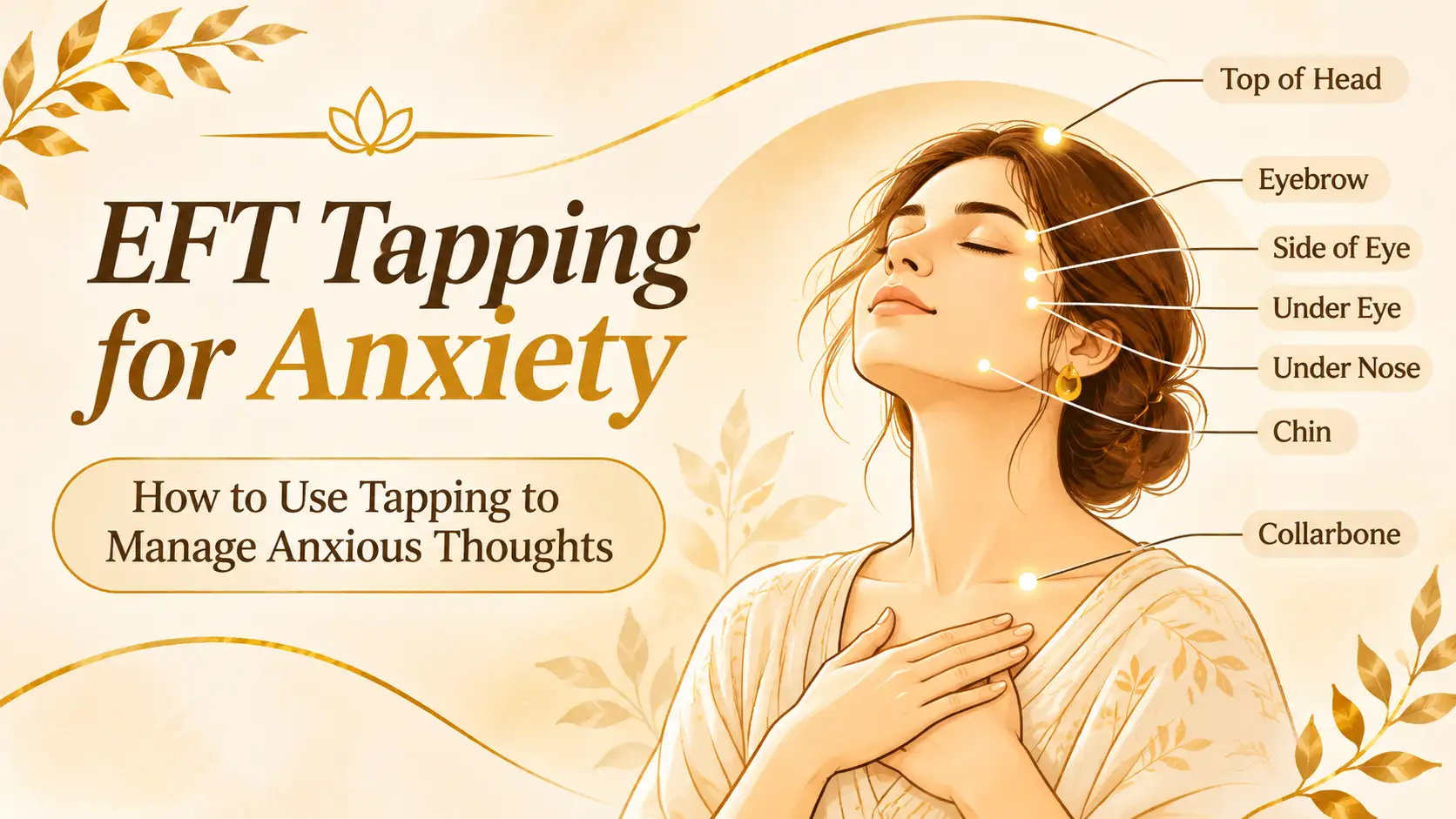
Common EFT Tapping Points
Many EFT sequences use a set of points tapped gently with the fingertips. The commonly used sequence includes:
- Side of the hand: The fleshy edge of the hand below the little finger. This is often used while saying the setup statement.
- Eyebrow: At the beginning of the eyebrow, near the bridge of the nose.
- Side of the eye: On the bone beside the outer corner of the eye, not on the eyeball.
- Under the eye: On the bone directly below the eye.
- Under the nose: The area between the nose and upper lip.
- Chin: The crease between the lower lip and chin.
- Collarbone: Just below the collarbone, near the point where it meets the breastbone.
- Under the arm: A few inches below the armpit, around the side of the rib cage.
- Top of the head: The crown of the head.
Use light, comfortable pressure. There is no need to tap hard, and you should avoid tapping directly on the eye or on an injured or painful area. Different EFT practitioners may teach slightly different sequences.
How to Do EFT Tapping for Anxiety: A Step-by-Step Guide
Step 1: Choose one specific anxious thought
Keep the focus narrow. Instead of choosing “my whole life feels stressful”, try something more specific, such as “I am anxious about tomorrow’s meeting” or “I keep worrying that I will make a mistake”. A clear focus makes it easier to notice what you are responding to.
Step 2: Rate the intensity
Pause and rate how intense the feeling is on a scale from 0 to 10, where 0 means no distress and 10 means the strongest distress you can imagine. This is a personal rating, not a medical test. You are simply recording how the moment feels to you.
Step 3: Say a setup statement
While gently tapping the side of your hand, acknowledge the feeling and include a phrase of acceptance. For example: “Even though I feel anxious about this meeting, I am willing to be kind to myself as I work through this feeling.”
You do not have to believe every word immediately. Choose language that feels honest rather than overly positive.
Step 4: Tap through the sequence
Move through the points listed above, tapping each gently several times. As you do, use a short reminder phrase that describes the concern, such as “this worry about tomorrow” or “this fear of getting it wrong”. Keep your attention on the specific feeling rather than rushing through the words.
Step 5: Pause and check in
Take a comfortable breath and notice what is happening. Has the intensity changed, stayed the same, or increased? Rate it again from 0 to 10. There is no correct result. If the feeling is unchanged, you do not need to force another round.
Step 6: Decide what support you need next
If you feel settled enough, consider one practical next step. You might prepare for the meeting, ask someone a question, take a short break, or write down what is within your control. Tapping should not become a way to avoid a real-world problem that needs attention.
A Simple EFT Tapping Script for Anxious Thoughts
You can adapt the following words to fit your own experience. Keep the phrases natural; they are prompts, not a formula you must repeat perfectly.
Setup statement – side of the hand
“Even though I feel anxious right now, I acknowledge that this is what I am experiencing. I do not have to judge myself for feeling this way.”
Repeat the statement up to three times if it feels comfortable.
Reminder phrases – move through the tapping points
- Eyebrow: “This anxious feeling.”
- Side of the eye: “So many thoughts running through my mind.”
- Under the eye: “I am worried about what might happen.”
- Under the nose: “I notice how tense I feel.”
- Chin: “I have been trying to figure everything out.”
- Collarbone: “For this moment, I can slow down.”
- Under the arm: “I can take this one step at a time.”
- Top of the head: “I can respond to this moment with patience.”
Pause after the round. Notice your breathing, your body, and the thoughts that are present. You can repeat the sequence with more accurate words if you want to explore a specific part of the worry. If focusing on the feeling makes you more distressed, stop the exercise and shift your attention to something grounding in your surroundings. Seek support if you need it.
Does EFT Tapping Really Help With Anxiety? What Does Research Say?
Research on EFT and anxiety is developing, and it is important to describe the findings carefully. A 2025 systematic review examined seven randomised controlled trials involving 506 participants. The review reported that the studies comparing EFT with no intervention found reductions in anxiety symptoms. However, the researchers also noted concerns about study quality, differences between protocols, and the need for larger, better-designed trials.
The US National Center for Complementary and Integrative Health (NCCIH) describes acupoint tapping as a complementary approach for which there is some evidence of possible benefit for anxiety, while noting that more research is needed. This is a more accurate way to understand the evidence than calling EFT a proven cure.
You can read more in the 2025 systematic review of EFT for anxiety disorders and the NCCIH overview of anxiety and complementary health approaches.
What EFT Tapping Cannot Replace
EFT tapping may be used by some people as a complementary self-help practice, but it should not be presented as a substitute for a mental health assessment or evidence-based treatment. Anxiety can be linked to a range of psychological, medical, situational, and environmental factors. A technique that feels helpful in one moment may not be enough when symptoms are persistent or significantly affecting daily life.
Consider speaking with a qualified mental health professional if anxiety is interfering with sleep, work, relationships, or everyday activities; if you are experiencing frequent panic episodes; or if your distress is becoming difficult to manage. If you are already receiving treatment or taking prescribed medication, do not stop or change it because of tapping.
If anxiety feels connected to earlier experiences or recurring emotional patterns, it may also be useful to explore whether Inner Child Therapy is relevant to your situation. This is a different approach, and whether it is appropriate depends on your needs and a proper discussion with a practitioner.
You can also read Transform Anxiety into Calm & Personal Power for a broader discussion of anxiety and possible ways of responding to it.
Taking the Next Step
Living with anxiety can be tiring, especially when your mind seems to be working even when you want to rest. EFT tapping offers one structured way to pause, acknowledge what you are feeling, and observe your response. It may be useful for some people, but it is not a universal solution—and you do not need to manage persistent anxiety on your own.
If you are unsure what kind of support would suit you, you can book a free consultation with Sonali Mittra to discuss your concerns and understand the available options. A conversation can help clarify what may be appropriate; it does not commit you to a particular therapy.
About the author: Sonali Mittra is a therapist and healing educator who works with emotional wellbeing and personal growth. The information in this article is for educational purposes and is not a diagnosis or a substitute for professional medical or mental health advice.
Frequently asked questions
EFT tapping may help some people manage feelings of anxiety and emotional stress. It combines gentle tapping on specific points with focused attention on uncomfortable thoughts or feelings. Research has reported promising results, but more high-quality studies are needed to establish its effectiveness.
To practise EFT tapping, identify one specific anxious thought, rate its intensity from 0 to 10, and repeat a setup statement while tapping the side of your hand. Then gently tap through the eyebrow, side of the eye, under-eye, under-nose, chin, collarbone, under-arm and top-of-head points while using short reminder phrases.
Some people report feeling calmer after a short tapping session, while others may notice little or no immediate change. There is no fixed timeline or guaranteed result. The experience can vary depending on the person and the nature of their anxiety.
Common EFT tapping points include the side of the hand, eyebrow, side of the eye, under the eye, under the nose, chin, collarbone, under the arm and top of the head. These points are tapped gently with the fingertips in a sequence.
Yes, some people practise basic EFT tapping independently for everyday stress and mild anxiety. However, if you experience severe anxiety, panic attacks or distress connected to traumatic experiences, it is better to seek guidance from a qualified mental health professional.
There is no universally established frequency. You can try a short session when you notice anxious thoughts and observe how you respond. Avoid forcing yourself to continue if tapping makes you uncomfortable or more distressed.
EFT tapping may help you pause and focus on a particular worry rather than continuously following anxious thought patterns. However, it does not guarantee that negative thoughts will disappear. Learning to recognise thought patterns and developing healthy coping strategies can also be important.
No. EFT tapping should not replace professional mental health treatment or prescribed medication. It may be considered a complementary self-help practice, but people experiencing persistent or severe anxiety should consult a qualified healthcare professional.
Where to start
If any of this describes something you recognise, the first step is a conversation rather than a commitment. A free consultation exists to work out what would genuinely help — including saying plainly if this is not the right approach for you.