You really want to apply for that role, send that message or say what you honestly think. And then a small voice kicks in: What if they say no? What if they laugh, ignore me or decide I’m too much?
You may prepare what you want to say, only to change your mind at the last moment. Staying quiet can feel easier than risking a response that might hurt or disappoint you.
If that sounds familiar, you’re not being dramatic. Fear of rejection is one of the most common, and most quietly limiting, fears there is. It can shape your career, your friendships and how safe you feel being yourself.
It is not always obvious. Sometimes it looks like perfectionism, people-pleasing, avoiding difficult conversations or constantly checking whether someone is upset with you. You may appear confident while privately worrying about being judged or excluded. Often, rejection becomes connected to a deeper fear about your value, belonging or emotional safety.
Here are 7 signs of fear of rejection, where it usually comes from, and gentle, practical ways to loosen its grip. You may recognise yourself in one sign or several. These patterns are not a diagnosis; they are starting points for understanding what happens when the possibility of disapproval feels threatening.
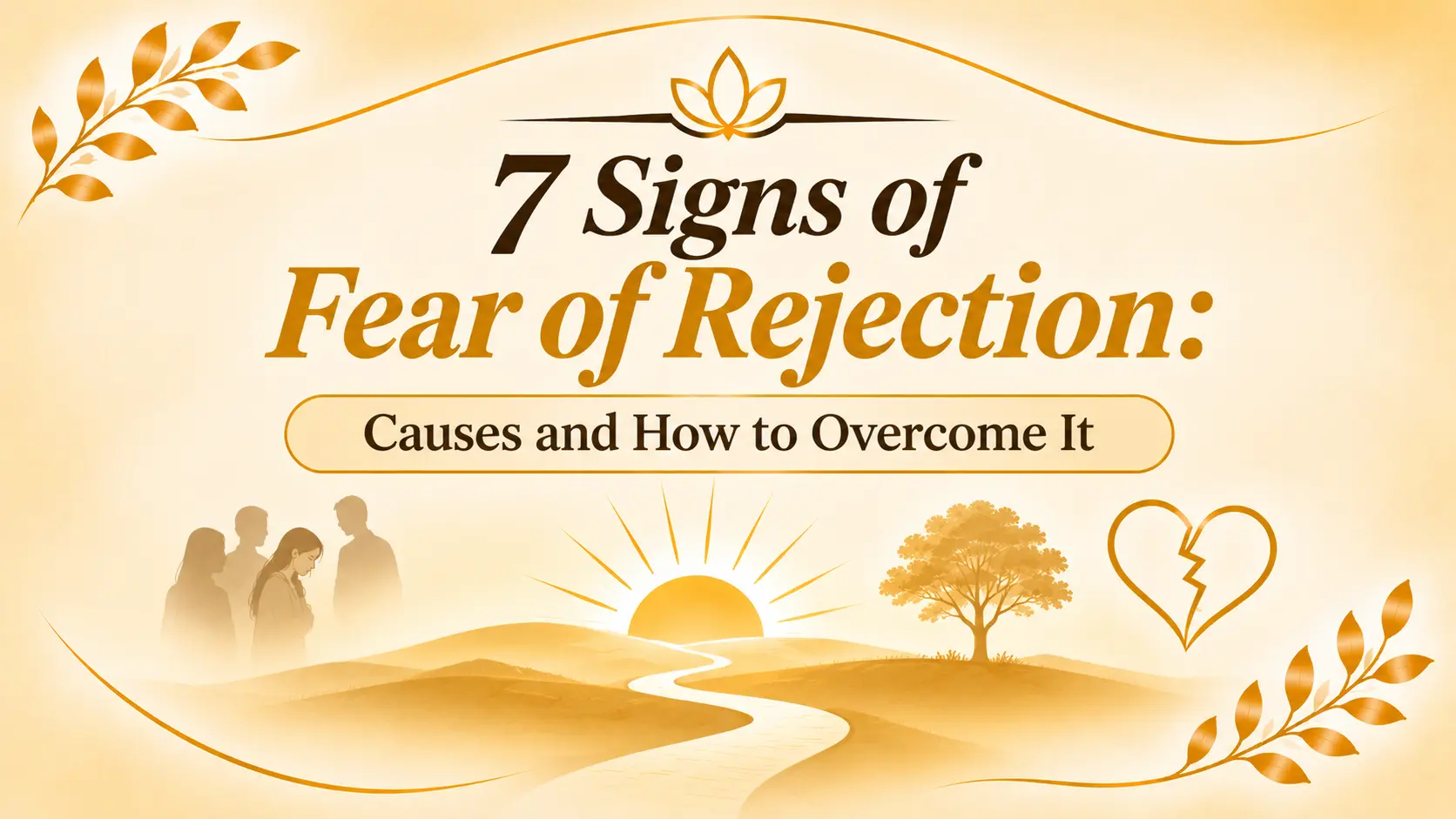
7 signs of fear of rejection
1. You say yes when you mean no
People-pleasing is often fear of rejection in disguise. If saying no feels risky, you may worry that people will pull away, become disappointed or think you are selfish. You might agree to plans when exhausted or take responsibility for problems that are not yours. Many people who grew up as the “good girl” or “good boy” know this well. If approval came when you were helpful or accommodating, you may have learned to keep others comfortable at your own expense. You can read more about the good girl syndrome, and about how constant helping can turn into a pattern like the saviour complex.
2. You overthink every message
You reread your texts, replay conversations and wonder if your tone was off. One slightly short reply can ruin your evening. You may draft and delete messages or keep checking whether the other person has seen them. Ordinary communication becomes exhausting when you analyse every word for clues that you might have upset someone. If your mind never switches off, our guides on how to stop overthinking and why women overthink may help.
3. You avoid putting yourself out there
You skip the application, keep your work to yourself or never ask for the date, the raise or the help. Not trying feels safer than being told no. Avoidance may bring immediate relief, but later it can leave you frustrated and wondering what might have happened if you had tried. Over time, the possibility of rejection can start deciding which opportunities you pursue.
4. You read neutral signals as rejection
A late reply means they’re upset. A quiet friend means they’re done with you. You may keep asking for reassurance, and still not quite believe it. The difficulty is that uncertainty starts to feel like evidence: instead of considering that someone may simply be busy, your attention goes straight to the explanation you fear most.
5. You hide your real opinions and needs
You agree to keep the peace, edit yourself in every room and shrink so that you’re easier to accept. You may hide disappointment or pretend something does not matter. Over time, it can leave you feeling like you don’t quite belong anywhere, even with people who love you. See feeling like you don’t belong in your family.
6. Criticism or being left out hurts far more than it “should”
Brain imaging research suggests that social rejection activates some of the same regions involved in physical pain. So if a “no” or an unreturned message stings deeply, that is a very human response, not weakness.
You may replay the incident or assume that one disappointing interaction says something permanent about you. The aim is to respond to the hurt without turning it into a judgement about your entire worth.
7. You pull away first
You go quiet, push people away or leave before anyone can leave you. You might stop replying after a disagreement or act indifferent when you feel hurt. It can give you a sense of control in the short term, but it may prevent honest conversations and cost you closeness in the long term. For more on this, read healing relationship insecurity from within.
Where does fear of rejection come from?
Psychologists use the term “rejection sensitivity” to describe a tendency to anxiously expect, notice and strongly react to possible rejection. Someone with high rejection sensitivity may interpret an unclear situation as rejection before they know what the other person intended. Common roots include:
- Conditional love in childhood. Approval that depended on being good, quiet, successful or helpful.
- Criticism, comparison or emotional neglect. Feeling not seen or not enough.
- Painful experiences of exclusion. Bullying, a hurtful breakup or being left out as a child.
- Pressure to fit in. The “log kya kahenge” voice, family expectations and roles you were handed early.
- Low self-worth. If you believe you’re “not enough,” a “no” confirms what you already fear. Read low self-worth and inner child healing.
Often, the fear belongs to a younger part of you who learned that being accepted meant being safe. A delayed reply or disagreement today can bring back that old uncertainty. That’s the inner child at work. It does not mean every difficulty comes from childhood; it means earlier experiences may shape how you respond today. Learn more in inner child wounds and healing childhood trauma.
How to overcome fear of rejection
- Notice the story. When you spiral, pause and ask: “What do I actually know, and what am I assuming?” A late reply is a fact. “They hate me” is a story. Try writing down the event and the meaning you have attached to it. Seeing the two separately can make the assumption easier to question.
- Start with small risks. Share an opinion, ask a question or request help with something manageable. Each time you face a “maybe” or a “no,” you learn that disappointment is uncomfortable but bearable. Build gradually rather than forcing yourself into overwhelming situations.
- Separate worth from outcome. A “no” may mean “not this, not now,” or that the other person has a different preference. It rarely means “you are unlovable.” Let yourself feel disappointed without using one person's response as a verdict on your value.
- Speak kindly to your inner child. Try saying: “I’m here. Even if they say no, I won’t leave you.” Ask yourself what you fear the rejection will mean, then offer the reassurance you need now. It can be surprisingly steadying.
- Practise gentle boundaries. Begin with low-stakes situations. Decline a small request, state a preference or ask for time to think. Notice that another person can feel disappointed without the relationship automatically ending.
- Get support. A therapist or counsellor can help you understand your triggers, the beliefs that keep the fear going and the behaviours you use to protect yourself. Inner child work may also help you explore earlier experiences. The aim is to build practical responses, not judge yourself for having the fear.
If the fear keeps you from work or relationships, makes you avoid everyday situations or leaves you anxious most days, it may overlap with social anxiety or low mood. The NHS overview of social anxiety is a helpful starting point, and a doctor or mental health professional can guide you further. You do not have to wait until things become unbearable before asking for support. If you ever have thoughts of harming yourself, please call 112 or Tele-MANAS at 14416 (free, 24x7).
Conclusion
Fear of rejection isn’t a flaw in your character. It’s a protection that once made sense, and that you may no longer need. But it can become limiting when it stops you from speaking honestly, trying something new or allowing people to know the real you.
You can’t guarantee that everyone will say yes. Some people will disagree with you or decide something is not right for them. Their response does not have to become a measure of your worth. You can learn that you’ll be okay, and still worthy, even when they don’t.
If you’d like gentle support with this, Inner Child Therapy with Sonali Mittra may help you reflect on earlier experiences and their influence on present-day responses. It is also available at The Healing Room in Bijwasan, New Delhi. Book a free consultation to discuss what may be suitable for your needs.
This article is for information and emotional support. It is not medical or psychological advice and does not replace diagnosis or treatment by a qualified professional.
Frequently asked questions
There is no single clinical name. Psychologists often use the term “rejection sensitivity,” and it can also overlap with social anxiety or fear of abandonment.
No, it is not a diagnosis on its own. It is a common emotional pattern. When it is severe or constant, it can be linked to anxiety, low mood or attachment difficulties, and a professional can help.
Common causes include conditional love or criticism in childhood, bullying or painful exclusion, family pressure, past relationship hurt and low self-worth.
Notice the stories you tell yourself, take small risks, separate your worth from outcomes, speak kindly to yourself and get support. Progress is gradual, and the fear softens with practice.
It can help some people understand where the fear began and offer themselves reassurance. It works best alongside other support, and it is not a replacement for professional mental health care when the fear is severe.
If the fear affects your work, relationships or sleep, or you feel anxious or low most days for two weeks or more, please speak to a doctor or mental health professional.
Where to start
If any of this describes something you recognise, the first step is a conversation rather than a commitment. A free consultation exists to work out what would genuinely help — including saying plainly if this is not the right approach for you.