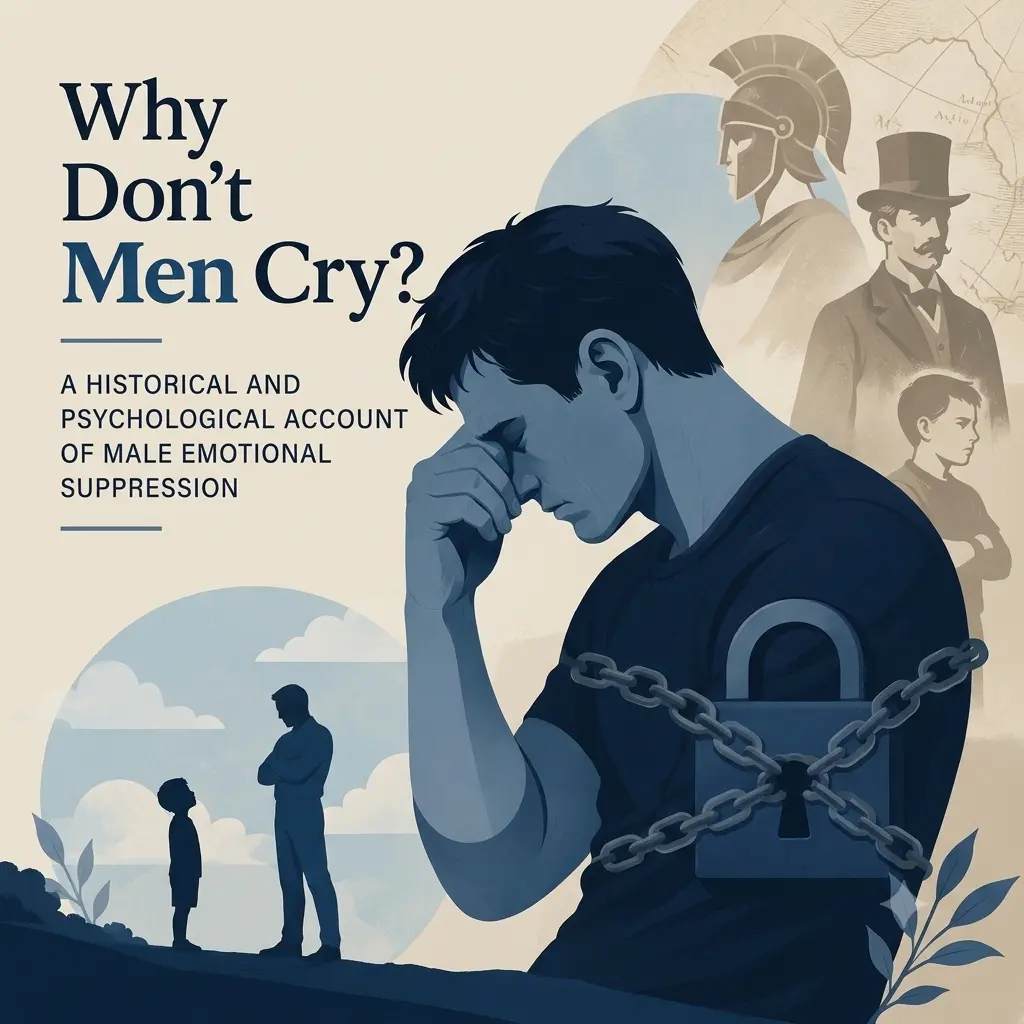
Why men don’t cry? It is one of those questions that sounds simple until you actually sit with it. We accept it as fact, almost as biology, the way we accept that men are generally taller or that their voices sit in a lower register. But emotional suppression is not biology. It is training. And like any trained response, it was built, generation by generation, for reasons that once made a brutal kind of sense.
Vikram’s father never cried. Not at his own father’s funeral. Not when the business collapsed. Not when Vikram, aged seven, broke his arm and his father held him in the hospital corridor with a steadiness that looked, from the outside, like strength. It was only decades later, when Vikram himself was in a therapist’s chair, unable to explain why he felt nothing at his own mother’s death, that he began to wonder what his father had actually been feeling behind that immovable face. And what it had cost him to keep it there.
Male emotional suppression is not a character flaw. It is not evidence of psychological shallowness or an absence of inner life. It is the predictable outcome of centuries of deliberate conditioning – social, historical, economic, and familial – that systematically taught men that emotional expression was incompatible with survival. Understanding where this came from is the first step toward understanding why it is so difficult to undo – and why work like Family Constellation, which traces these patterns back through a family’s history, often reaches what conventional conversation cannot.
Why Men Don't Cry: A Brief History
The equation of masculinity with emotional stoicism is not universal or timeless. It is historically specific. For much of pre-industrial human history, men’s emotional lives were considerably more visible. Ancient literature is rich with men weeping openly: Achilles weeping for Patroclus, Odysseus weeping for his home, the great warrior heroes of Sanskrit epics moved to tears without shame. Emotional expression, including grief, was not considered incompatible with strength.
The shift began, historians argue, with industrialisation. The 18th and 19th centuries created a new economic order that separated the male sphere (production, rationality, the marketplace) from the female sphere (emotion, nurture, the home). Emotional expression in men became associated with femininity, and therefore with weakness, unreliability, and unfitness for the competitive demands of the new economy. Men who showed feeling were not to be trusted with serious matters.
Two world wars accelerated this catastrophically. Entire generations of men were sent to experience unimaginable horror and explicitly told that processing it was self-indulgent, even treasonous. The stiff upper lip was not a personality type. It was a survival instruction issued at scale.
Historian Joanna Bourke’s research on male experience in World War I found that soldiers who expressed emotional distress were frequently diagnosed with “lack of moral fibre,” a military designation that carried serious professional and social consequences. The message was unambiguous: your feelings are a liability.
How “Boys Don't Cry” Gets Passed Down
This conditioning does not require explicit instruction. It is transmitted through observation, through the absence of role models who process emotion openly, and through the swift correction that arrives whenever a boy steps outside the permitted emotional range.
“Boys don’t cry.” “Man up.” “Don’t be such a girl.” “Toughen up.” These phrases are not simply cultural clichés. They are active interventions in a child’s emotional development. Every time a boy is shamed for showing fear, sadness, or vulnerability, he learns to route those experiences underground. Not to stop feeling — he cannot stop feeling — but to stop showing. The emotion does not disappear. It goes somewhere else.
Research building on psychologist Joseph Pleck’s foundational gender role strain paradigm shows that boys begin suppressing emotional expression from a young age in response to peer and adult feedback, and that this suppression becomes progressively more entrenched through adolescence — not through natural development, but through sustained social reinforcement.
If Men Don't Cry, Where Does the Emotion Go?
The emotions that men are not permitted to express do not evaporate. They express themselves through the only channels that remain socially permissible:
- Anger – the one emotion consistently coded as masculine.
- Physical symptoms – tension, chronic pain, cardiovascular strain.
- Addiction and risk-taking – as a substitute release valve.
- Overwork – channelling everything into productivity instead of feeling.
- Breakdown – when the body can no longer contain what the mind will not acknowledge.
Men die by suicide at three to four times the rate of women across most countries. Men are significantly less likely to seek mental health support. Men present to doctors later in the progression of illness, for both physical and psychological conditions. These are not evidence of male stoicism as a virtue. They are evidence of a wound so deep and so normalised that its carriers cannot always see that they are bleeding.
What Family Constellation Reveals About Male Emotional Suppression
In Family Constellation session work, male clients almost always find, somewhere in their lineage, a figure who suffered enormously and was given no space to process that suffering. A father who returned from war and was expected to simply continue. A grandfather who lost everything and rebuilt in silence. A great-uncle whose grief was never named. The current generation man often carries the accumulated unexpressed emotion of these figures, not because he was told to, but because the family system, in its loyalty, keeps the account open until someone is ready to close it.
The constellation moment that moves male clients most deeply is usually not a dramatic revelation. It is a simple one: the permission to feel what has always been there. The realisation that the numbness was protection, not nature. And beneath the protection, a man who has been waiting, sometimes for decades, for it to be safe enough to be human.
“Strength was never the absence of feeling. It was the courage to feel, and continue anyway.”
What Becomes Possible When Men Stop Suppressing
When men begin to access the emotional range that was trained out of them, the effects are profound, not just personally, but relationally and generationally. The father who can name his feelings raises children who are not ashamed of theirs. The partner who can express vulnerability creates space for genuine intimacy rather than managed distance. The man who can grieve stops carrying grief in his body as illness.
This is not about encouraging men to become someone they are not. It is about returning them to the full range of who they have always been, before the world decided that half of their humanity was inconvenient.
Where to start
If any of this describes something you recognise, the first step is a conversation rather than a commitment. A free consultation exists to work out what would genuinely help — including saying plainly if this is not the right approach for you.