Meera had been to eleven doctors in three years. Every test came back inconclusive. The pain in her lower back was real – she could barely walk on bad days – but no structural cause could be found. The migraines that arrived every Sunday evening, predictably, mysteriously, were treated with increasing doses of medication that dulled them but never cured them. The fatigue that sat on her chest like a stone defied every blood panel.
“It might be stress,” one doctor finally offered, almost apologetically.
Meera drove home feeling something between relief and devastation. Stress. As though that were a small thing. As though the body were being dramatic on behalf of feelings she had not been able to express for fifteen years of a marriage she had chosen to remain in.
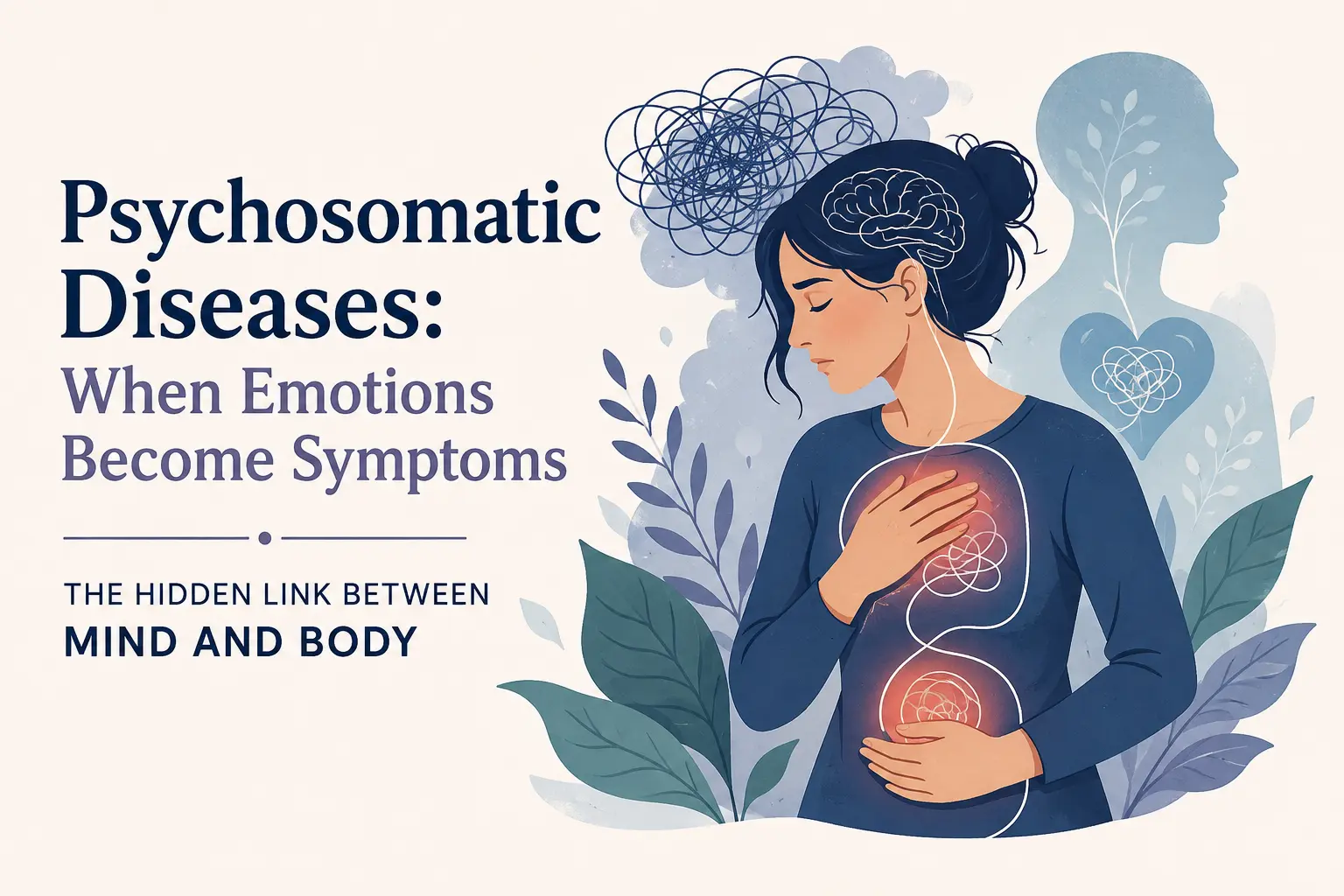
Many people living with psychosomatic diseases spend years searching for physical explanations, only to discover that unresolved emotional stress, trauma, and nervous system overload may be contributing to their symptoms.
Meera’s body was not betraying her. It was telling the truth – in the only language left available to it.
What Psychosomatic Actually Means
The word psychosomatic has been unfairly burdened with the implication of “made up”. In reality, it means precisely the opposite: it means that the psychological and the somatic — the mind and the body — are not separate systems, and that what one holds, the other expresses. A psychosomatic illness is a real physical illness with a significant psychological dimension.
The term psychosomatic diseases refers to genuine physical conditions influenced by emotional, psychological, and nervous system factors. The pain is genuine. The inflammation is measurable. The symptoms are not invented.
What is different is the origin — and therefore, what is required to truly heal.
📌 The American Psychological Association estimates that 75 to 90 percent of all visits to primary care physicians involve complaints that are stress-related or psychosomatic in nature. The body does not lie — it simply speaks in a language medicine has been slow to fully learn.
The Mind-Body Connection Is Stronger Than We Think
For centuries, medicine treated the mind and body as separate systems. Modern neuroscience increasingly suggests otherwise. Every emotion creates a biochemical response. Every stressful experience leaves an imprint on the nervous system. Every unresolved emotional burden has the potential to influence physical wellbeing.
This is why the relationship between emotions and physical illness has become such an important area of research. Chronic stress affects hormone production, immune function, inflammation, digestion, sleep, and pain perception. Over time, these changes can contribute to symptoms that appear purely physical while carrying a significant emotional component beneath the surface.
Many people seeking mind body connection healing discover that lasting recovery begins not when symptoms are fought, but when they are finally understood.
The Emotions Most Commonly Stored in the Body
Different emotional states have different somatic signatures — specific areas of the body where they tend to accumulate when they are not expressed or processed. Research into psychosomatic diseases continues to show that chronic emotional stress can influence how symptoms appear and persist throughout the body.
This is not mysticism. It is the clinical observation of somatic therapists, neuroscientists, and trauma researchers across decades of practice.
Grief and sadness tend to accumulate in the chest and lungs — the tightness that makes breathing feel effortful, the recurring respiratory infections, the asthma that worsens in emotionally difficult periods.
Anger and resentment live in the jaw, the neck and shoulders — the grinding teeth, the tension headaches, the chronic stiff neck that no massage permanently resolves.
Fear and anxiety settle in the gut and lower back — the irritable bowel, the chronic digestive distress, the unexplained aches that emerge during periods of emotional overwhelm.
Unspoken truth and suppressed expression frequently manifest in the throat — recurring throat infections, difficulty swallowing, or a voice that seems to disappear precisely when it is needed most.
📌 Dr. Bessel van der Kolk’s landmark research, published in his seminal work The Body Keeps the Score, demonstrated through neuroimaging that traumatic and suppressed emotional experiences create measurable changes in the brain and nervous system — which then manifest as physical symptoms that persist until the underlying experience is processed.
Why Psychosomatic Diseases Often Remain Misunderstood
One of the greatest challenges facing people with psychosomatic diseases is that their symptoms are often dismissed. Friends may suggest the illness is “all in the head.” Family members may encourage them to simply think positively. Even healthcare professionals sometimes struggle to explain symptoms that cannot be linked to a clear structural cause.
Yet the absence of a visible cause does not make the suffering less real.
The nervous system has extraordinary power over physical experience. A person can experience severe pain, chronic fatigue, digestive issues, migraines, autoimmune flare-ups, skin conditions, and sleep disturbances even when standard medical investigations fail to identify a specific pathology.
The body is not inventing symptoms.
The body is communicating.
The Family System and the Body
Family Constellation adds a layer to psychosomatic understanding that conventional medicine rarely considers: the possibility that the illness does not originate solely in this person’s life, but in the family system they were born into.
For some people experiencing psychosomatic diseases, emotional burdens may be connected to stories, losses, traumas, exclusions, or hardships that belong to previous generations. Descendants of people who experienced violence, displacement, famine, abandonment, or sudden traumatic deaths sometimes present with emotional and physical patterns that appear remarkably similar to those carried by their ancestors.
A client with chronic chest pain discovers, through constellation work, an ancestor whose grief was never acknowledged. A woman with persistent skin conditions traces them, through the family field, to a grandmother who lived in constant fear and vulnerability.
These connections cannot always be verified scientifically. Yet the shifts that occur after these hidden dynamics are recognized often invite deeper reflection.
The Question the Body Is Always Asking
Every chronic, medically unexplained symptom is asking a question on behalf of the person carrying it.
Not: What is wrong with me?
But: What has not yet been said? What has not yet been felt? What has not yet been acknowledged?
Many cases of psychosomatic diseases invite a deeper question: what emotional truth is still waiting to be heard?
The body, in its extraordinary wisdom, finds a way to make the invisible visible. The migraine that arrives every Sunday is not necessarily random — it arrives when the week’s performance is over and the self, briefly, has nowhere to hide.
The back pain that grounds a woman who has been carrying everyone else’s responsibilities for twenty years is not necessarily random either. It may be the body’s way of insisting that something must finally change.
“The body is not your enemy. It is the most honest part of you — the part that keeps the account when the mind has decided to look away.”
What Healing Looks Like
Healing psychosomatic diseases requires working at both levels simultaneously: supporting the body with appropriate medical care while addressing the emotional and systemic dimensions that the illness may be expressing.
The goal is not to choose between physical and emotional explanations. The goal is to recognize that both may be true.
Access Bars, which works directly with the nervous system and the brain’s electromagnetic activity, can help release the accumulated stress that often underlies psychosomatic symptoms. Family Constellation addresses hidden systemic patterns that may be influencing present-day experiences. Personal Facilitation creates the space to finally say, feel, process, and integrate what the body has been carrying.
The body wants to heal. It was never designed to carry everything alone.
With the right support, it can release what no longer belongs to it. The symptoms that once served as a language may gradually become unnecessary because the truth they were speaking has finally been heard.
Understanding psychosomatic diseases is not about dismissing physical symptoms. It is about recognizing the profound relationship between stress and chronic illness, the connection between emotions and physical illness, and the remarkable intelligence of the human body.
This is exactly the kind of pattern that Access Bars, Family Constellation, or Personal Facilitation can help you understand and release.
Book a free consultation with Sonali Mittra – online sessions available worldwide.
Where to start
If any of this describes something you recognise, the first step is a conversation rather than a commitment. A free consultation exists to work out what would genuinely help — including saying plainly if this is not the right approach for you.